
Two Journals, One Mission – Better Quality Healthcare
Explore the flagship International Journal for Quality in Health Care (IJQHC) and its open-access companion, IJQHC Communications (IJCOMS).
Your Evidence Base Starts Here
Explore ISQua Healthcare Journals
From implementation science to health-services economics, ISQua’s journals keep healthcare professionals at the frontier of quality improvement. IJQHC publishes gold-standard studies and policy analyses, while IJQHC Communications fast-tracks practical research and early findings – all rigorously peer-reviewed, indexed, and ready to inspire change in your setting.
Inside IJQHC & IJCOMS Healthcare Journals
IJQHC – International Journal for Quality in Health Care
The International Journal for Quality in Health Care is ISQua’s flagship, peer-reviewed publication covering research, policy, and implementation in healthcare quality and safety.
What’s inside:
- Health-services research & programme evaluation
- Quality-improvement methods and outcomes
- Patient-safety science & clinical risk management
- Health-care policy, economics, and management
- System-level quality measurement & benchmarking
- Clinical research focused on care quality and safety
Editor-in-Chief: Sir Prof Aziz Sheikh, University of Oxford.
Members get full online access automatically.
IJQHC Communications – International Journal for Quality in Health Care Communications
The International Journal for Quality in Health Care Communications is fully open-access and implementation-focused – ideal for rapid dissemination of quality-improvement studies, protocols, and insights.
What’s inside:
- Implementation-science studies in real settings
- Technology assessment, usability, and digital safety
- Health-economics evaluations & cost-containment models
- Utilisation review and value-based care analytics
- Nursing, allied health, and social-care quality research
- Protocols, pilot projects, and cascaded submissions from IJQHC
Editor-in-Chief: Dr Richard Greenhill, USA.
Open access for every reader, everywhere.
IJQHC Seminar Series -
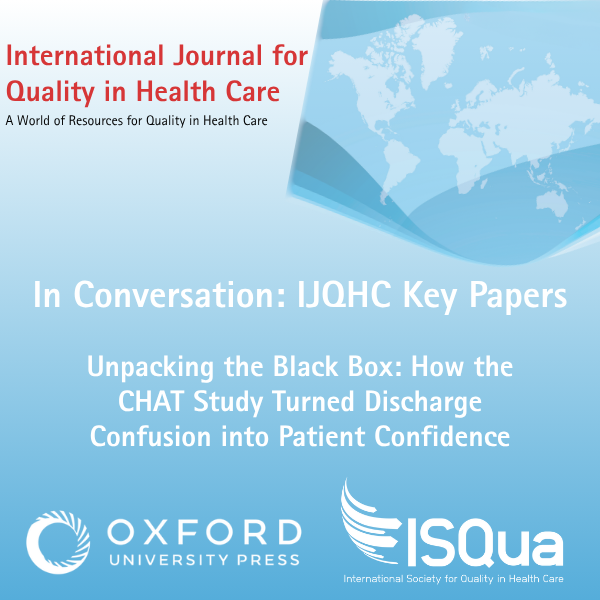
In Conversation: IJQHC Key Papers
Each year, the International Journal for Quality in Health Care (IJQHC) publishes research that advances how we design, lead and evaluate quality improvement of health systems. IJQHC Key Papers is a new interview series in which Professor Reece Hinchcliff (Deputy Editor, IJQHC) speaks with authors of selected key papers published in the journal throughout the year.
In each episode, we unpack the study itself, including its aims, methods, findings, and why it matters for quality, safety, and health system performance. We also go behind the paper: authors reflect on the challenges they navigated, the pivotal decisions that strengthened the work, and the research and career pathways that brought them to this point.
Designed for researchers, clinicians, managers, policymakers, and students, the series offers an accessible window into high-impact IJQHC scholarship and the people who produce it. It also highlights practical lessons you can apply to your own research, writing, and real-world impact.
Our first interview is with the authors of the winning 2025 Reizenstein Award, for their paper “Co-design of an intervention to improve patient participation in discharge medication communication.”

Call for Papers for Supplement on Uncertainty and Trust in Healthcare
Modern healthcare in the post-pandemic era is characterised by profound uncertainty. Financial and political volatility, rapid technological advancement, evolving regulatory landscapes, and increasing system complexity are reshaping care delivery. At the same time, healthcare systems face significant pressures on the workforce, learners and educators, clinicians, patients, and families—alongside a concerning erosion of trust in healthcare institutions.
This IJQCH supplement invites contributions that define, examine, and advance understanding of uncertainty and trust in healthcare. We seek papers that explore conceptual frameworks, empirical research, and practical strategies to support the delivery of high-quality, person-centred care in environments marked by complexity and unpredictability. Submissions may address how trust can be built, sustained, or restored, and how healthcare systems can adapt and improve under conditions of uncertainty.
Latest Issues
Each new issue distils the freshest thinking in quality improvement into peer-reviewed studies, policy analyses, and case reports. Scan the highlights below to spot breakthrough methods, compare global benchmarks, and gather evidence you can cite in tomorrow’s safety briefing or funding pitch.
Productivity is not enough: re-establishing the foundations of value in digital health
Almost three decades ago, the Institute of Medicine published To Err is Human: Building a Safer Health System [1]. The report recognized that to be safer, healthcare systems must be redesigned to reduce preventable harm, reframing patient safety as a systems...
When home becomes the best hospital
Hospital at Home (HaH) has become a transformative model of healthcare, particularly in countries facing population ageing, rising healthcare costs, and constrained hospital capacity. In our Journal, Villegas Bruguera et al. [1] recently published a retrospective observational study, conducted over 2...
Advance Articles
We offer a number of open access, advance journal articles for non-members to enjoy. Subjects include: health services research, health care evaluation, policy, health economics, quality improvement, management, and clinical research.
AbstractBackgroundDigital tools can prepare patients for decisions, but effects on clinical dialogue are uncertain. We synthesized review-level evidence on shared decision-making and examined the role of timing and workflow.MethodsWe rapidly reviewed systematic, meta-analytic, and scoping reviews identified through targeted PubMed,...
AbstractBackgroundHome-based medication administration is vital for managing paediatric chronic conditions but is prone to errors that affect patient safety and outcomes. Children suffering from chronic conditions such as cancer, diabetes, epilepsy, and sickle cell disease frequently require medication outside hospital...
AbstractBackgroundThe post-discharge period is vulnerable because gaps in continuity of care may increase adverse outcomes. This study aimed to describe the implementation of a structured post-discharge follow-up program and the outcomes observed during follow-up at a specialised cardiovascular referral centre...
Latest Issues
Each new issue distils the freshest thinking in quality improvement into peer-reviewed studies, policy analyses, and case reports. Scan the highlights below to spot breakthrough methods, compare global benchmarks, and gather evidence you can cite in tomorrow’s safety briefing or funding pitch.
AbstractBackgroundDiagnostic phlebotomy contributes to hospital-acquired anaemia and generates economic and environmental burdens.ObjectiveWe evaluated changes in blood collection, transfusion use, direct tube-acquisition costs, and plastic consumption after implementation of a hospital-wide blood-sparing sampling protocol.MethodsThis retrospective pre–post cohort study compared the 12 months...
AbstractBackgroundHospitals face increasing pressure to maintain safe staffing while controlling labour costs. Nursing absenteeism, vacancies, turnover, and day-to-day demand variation often generate overtime coverage and additional staffing expenditure. Visual management may improve operational transparency, but its application to nursing workforce...
AbstractThe 60:30:10 problem is well established in healthcare: on average, ∼60% of care aligns with evidence and guidelines; ∼30% of expenditure on care is wasteful; and ∼10% of encounters result in an adverse event, near miss, or serious harm to...
Advance Articles
We offer a number of open access, advance journal articles for non-members to enjoy. Subjects include: health services research, health care evaluation, policy, health economics, quality improvement, management, and clinical research.
Looking for More Healthcare Professional Resources?
Whether you’re writing your first paper, or have specific questions, we’re here to help with FAQs and video resources for early career researchers.

Never Miss an ISQua Healthcare Journal Issue
Want new research, editor’s picks, and open-access articles delivered straight to your inbox? Log in or register a personal Oxford Academic account below to set up quarterly journal alerts.