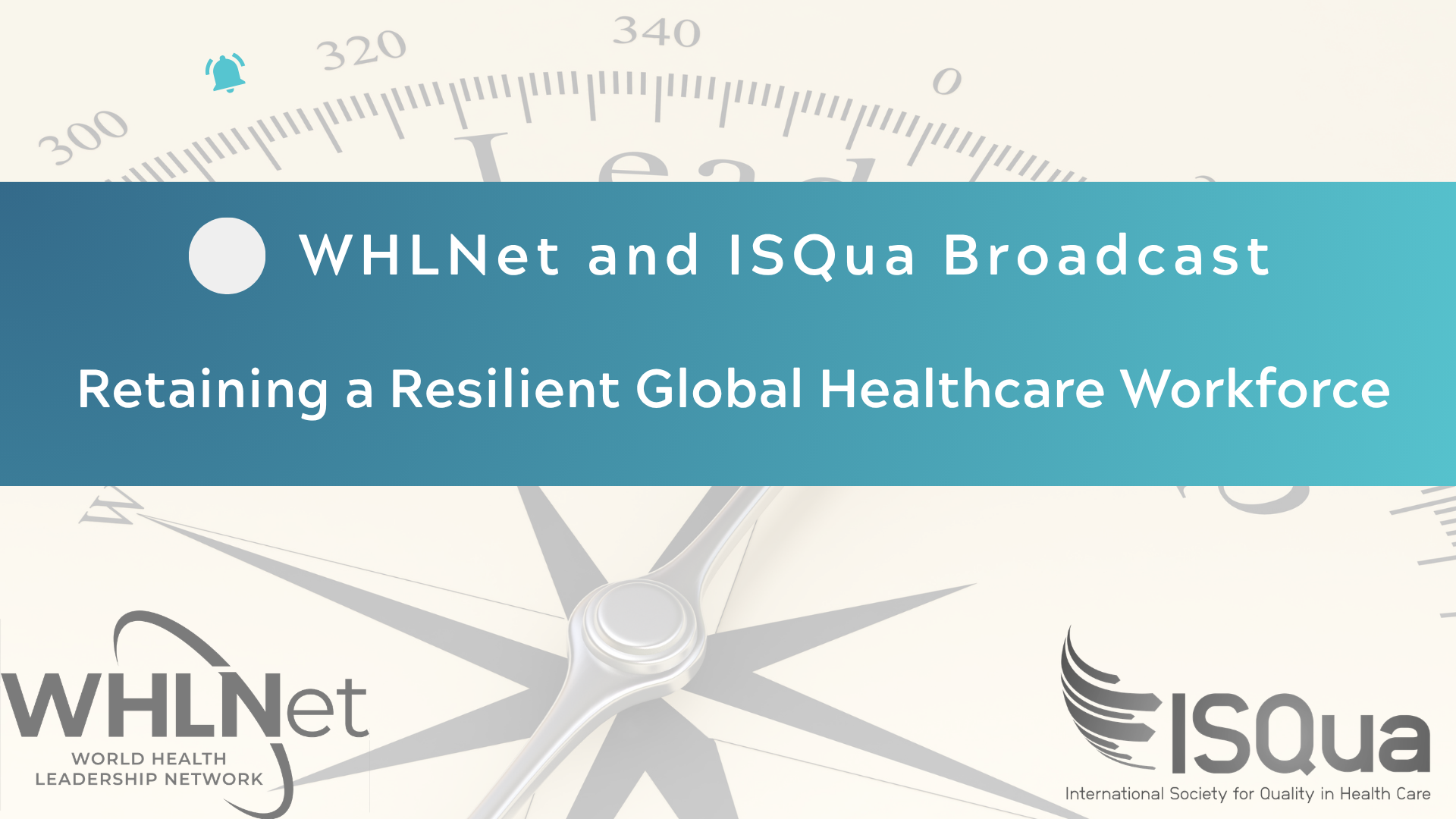
On 16 April 2026, the World Health Leaders Network (WHLNet), in partnership with ISQua, convened a global conversation on one of the most pressing challenges facing health systems today: how to retain a committed, capable healthcare workforce in the face of rising demand, growing complexity, and intensifying international competition for talent.
Bringing together speakers from across four continents, the session moved beyond familiar narratives of workforce shortages to explore a more nuanced question: what actually anchors people in healthcare, and what pushes them away?
From recruitment to retention—and beyond
A consistent theme across the session was a deliberate shift away from focusing solely on recruitment. While attracting staff remains critical, the discussion emphasised that retention is fundamentally shaped by organisational, cultural, and relational conditions, not just workforce supply.
As the Graham Dickson, the session moderator framed it, the challenge is not only ensuring that professionals enter the workforce, but that they are supported to “stay, thrive and build sustainable careers” in increasingly demanding environments.
This framing set the tone for contributions from four international speakers, each offering grounded insights from their own health system context.
What keeps people in the system?
From Chile, Dr Claudia Hernández highlighted a striking paradox: even in high-pressure environments characterised by workload challenges and administrative burden, many physicians still choose to stay.
Her reflections pointed to two critical anchors. First, professional identity, particularly the academic dimension of medicine, including teaching and research, provides a strong sense of purpose. Second, relationships matter: the strength of team connections and a sense of belonging within professional communities can outweigh less favourable working conditions.
This reframes retention as not simply about reducing dissatisfaction, but about strengthening meaning, identity, and connection. The key question becomes not just “why do people leave?” but “what continues to anchor them, even when conditions are imperfect?”
When staying is not the same as thriving
Dr Fury Maulina’s perspective from Indonesia provided further insights into retention. In rural and underserved areas, workforce challenges are shaped by structural inequities: heavier workloads, limited resources, unclear career pathways, and non-merit-based progression systems.
Yet even in these contexts, some healthcare workers report a strong sense of personal fulfilment, often rooted in community connection and service.
This raises a critical distinction: do people stay because they are thriving—or because they have limited alternatives? As Dr Maulina posed, “Is that retention or endurance? Do people stay because they are thriving or because they have no option? And therefore how do we identify this as problematic or healthy retention?”
For system leaders, this question is not rhetorical. It challenges simplistic interpretations of retention metrics and calls for deeper examination of workforce experience.
Shifting the focus: from resilient individuals to resilient systems
A major conceptual pivot came from Dr Cecilie Haraldseid-Driftland’s work across a multi-country European research programme. Her central argument was clear: the problem is not a lack of resilience in individuals, it is the need for more resilient organisations.
Rather than asking healthcare workers to cope better, systems must be designed so that people can do their jobs effectively and sustainably.
Her research identified five core conditions that support retention across diverse settings:
- Opportunities for continuous learning and growth
- Recognition of life beyond work (and its impact on performance)
- Autonomy and voice in day-to-day work
- Shared expectations about roles and demands
- Strong, trust-based relationships.
Notably, many of these are relational and cultural rather than purely structural, highlighting that retention is not solved through policy alone.
The operational reality: pressure, loss, and leadership
From Kenya, Dr Lydia Okutoyi brought a practical perspective grounded in frontline leadership. Her account illustrated the cumulative pressures facing large public hospitals: workforce shortages, industrial action, high patient demand, and the ongoing loss of experienced staff to international migration.
These challenges are compounded by demographic shifts (including impending retirements), gaps in specialised skills, and constraints on recruitment.
Yet within this context, leadership remains a critical lever. Dr Okutoyi emphasised the importance of listening, trust-building, and supporting career progression, even where systemic constraints limit immediate solutions.
Her reflections underscored a simple but often overlooked point: retention is not only about systems and structures, but about how people experience leadership on a daily basis.
A broader conversation about systems, identity, and responsibility
The breakout discussions extended these themes, surfacing deeper questions about responsibility and agency. Participants challenged the idea that “resilience” should be located primarily at the individual level, arguing instead for a shift towards system-level accountability.
At the same time, the conversation recognised that systems are not abstract entities, they are enacted through people, particularly leaders. Organisational culture, expectations, and working conditions are shaped through everyday decisions about priorities, resources, and behaviours.
This creates a tension: while structural change is essential, it ultimately depends on human action at multiple levels: individual, team, organisational, and system-wide.
Where next?
What emerged from this session was not a single solution, but a more sophisticated understanding of workforce retention. Three implications stand out.
First, retention is relational. It depends not only on pay, workload, or policy, but on identity, belonging, and connection.
Second, retention is contextual. What works in one system may not translate directly to another, and global dialogue is essential to surface both common patterns and local nuance.
Third, retention is a leadership issue. Whether through designing learning environments, enabling autonomy, or building trust, leaders play a central role in shaping whether people stay, and whether they thrive.
As health systems continue to grapple with workforce challenges, the task is not simply to make individuals more resilient, but to create conditions in which resilience is no longer a requirement for survival, but a foundation for thriving.
Watch the recording – https://vimeo.com/1187707686/85f2065d87?share=copy&fl=sv&fe=ci
World Health Leadership Network (WHLNet)
The purpose of this network is to facilitate global collaboration and address shared challenges among healthcare leaders worldwide. The events are engaging, interactive sessions with opportunities for participants to discuss a chosen theme from different national perspectives worldwide.
Further information on previous broadcasts can be found on the CHLNet website