Reflections from ISQua’s North American Community of Practice webinar for World Patient Safety Day 2026
A child who depends on a ventilator, feeding tube or several medications may spend only a small part of their life in a hospital. Most of their care takes place at home, at school and in the community. Yet families are often left to connect the professionals and services involved, manage equipment and prescriptions, and spot when something is wrong.
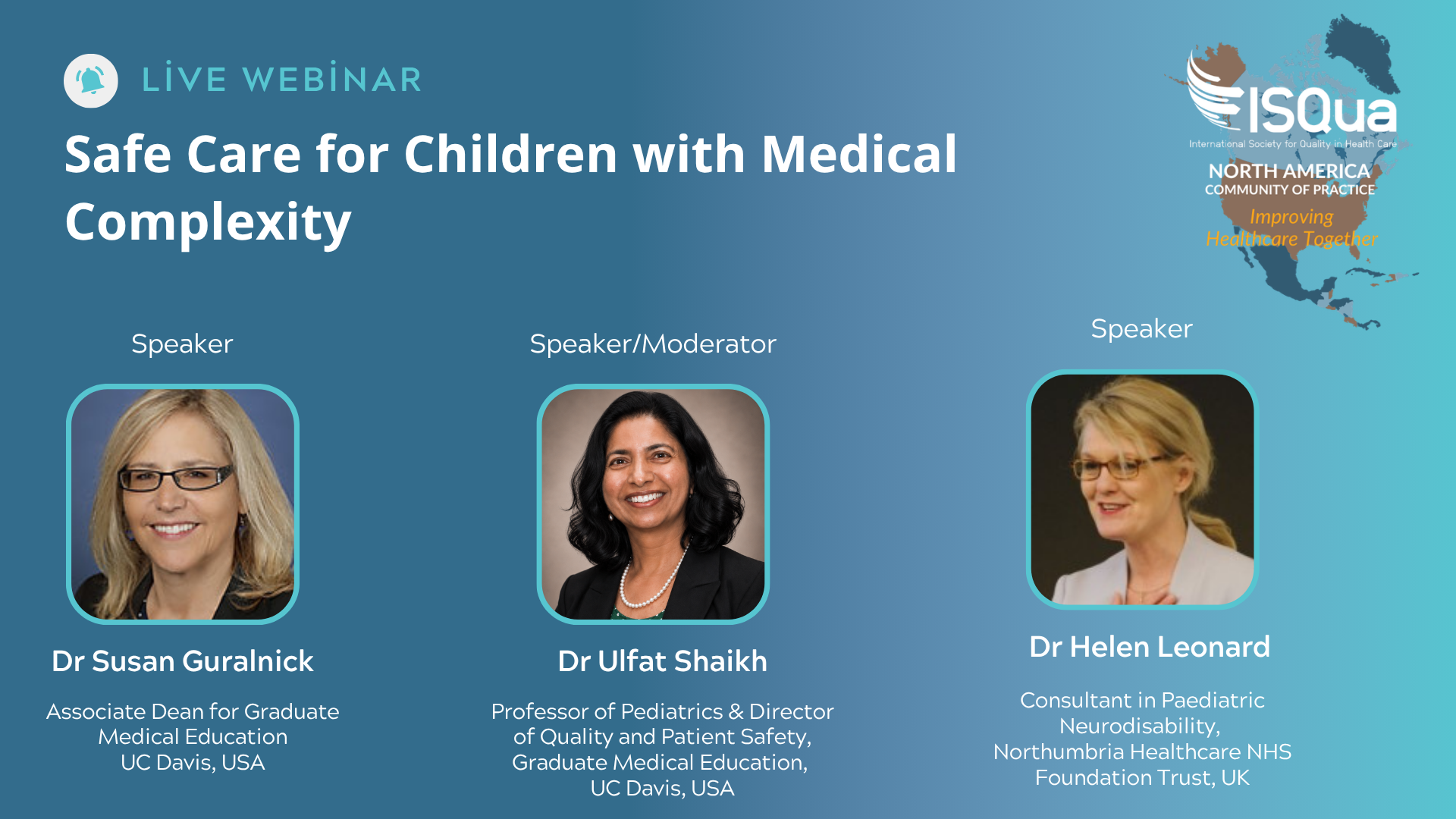
That was the starting point for Safe Care for Children with Medical Complexity, an ISQua North American Community of Practice webinar held on 17 September to mark World Patient Safety Day. Moderated by Dr Ulfat Shaikh, the conversation brought together Dr Susan Guralnick, a paediatrician at UC Davis, and Dr Helen Leonard, a UK consultant paediatrician who also spoke about her experience as the parent of a young adult with complex disabilities.
Their message was clear: safe care depends on listening to families while ensuring that health and care services carry their share of the work.
See the care that happens at home
Dr Leonard urged participants to look beyond the moments when a child enters a clinic or emergency department. Advances in treatment and technology mean that families may now provide highly technical care at home, sometimes around the clock. But access to trained support, suitable equipment, home adaptations and respite does not always keep pace.
She described families effectively running small intensive care or high dependency units in their homes, often while exhausted and trying to coordinate paid carers, education and social services. Dr Guralnick added that even getting the right equipment can be a struggle. Both speakers stressed that supporting a child safely also means supporting the people caring for them. Families should not have to reach a crisis before they can get help.
Give coordination a clear home
For Dr Guralnick, a reliable point of contact is essential. She described the value of a primary care “medical home”: a clinician who knows the child, keeps track of specialist input and can help the family reach the right person when a question or problem arises. Social workers and other colleagues can help with equipment and, in the US context, insurance.
Dr Leonard drew attention to another layer of coordination: arranging prescriptions and repairs, getting to appointments, and working across health, education and social care. Much of this work falls to families even when clinicians believe care is coordinated. She called for this wider coordination role to be defined, funded and supported, and suggested that experienced parents could make valuable contributions if properly trained and paid.
The test of coordination is what happens when a family needs help: do they know whom to contact, and will that person take responsibility for connecting the next steps?
Treat families as experts without making them the safety net
Parents and carers often recognise subtle changes that are invisible to someone meeting a child for the first time. Dr Leonard gave the example of a family recognising a seizure that may not look typical to an unfamiliar clinician. Their observation needs to be heard and investigated, not dismissed. She also offered a simple sign of respect: learn and use parents’ names rather than referring to them only as “mum” or “dad”.
Dr Guralnick noted that families differ in the decisions they want to make and the support they need. A good partnership starts by asking, listening and adapting. When a child is referred to an emergency department or seen by an unfamiliar clinician, a direct handover can help the receiving team understand both the child’s history and the family’s knowledge.
That expertise, however, should never become an excuse to leave parents to fill every gap in the system. The speakers discussed the need for trained home support and respite, including when families rely on relatives or other carers because professional help is unavailable.
Make instructions usable in real life
More information does not automatically make care safer. If several specialists give different instructions, someone needs to resolve the conflict and agree a plan the family can actually follow. Dr Guralnick described talking through care plans with families, providing written steps when helpful, and checking at the end of a visit whether their concerns have been addressed.
Dr Leonard illustrated why communication needs to fit each family. In one case, carefully written medication instructions were not working because the parent could not read English. Working with a community pharmacist to mark the correct dose on syringes made the instructions usable. She also cautioned against assuming that one family member can reliably translate complex care information for another.
Medication management requires similar attention to detail. Dr Guralnick described comparing a child’s current and previous medication lists with the family and carefully checking high risk medicines on home nursing orders. Dr Leonard highlighted the risk of liquid medicines supplied in different concentrations. Both encouraged clinicians to review whether each medicine is still needed and, where clinically appropriate, choose schedules that are easier for families to manage.
Ask what burden you can remove
At the close of the webinar, Dr Leonard asked clinicians to find out what would make care easier for an individual family. A later appointment, for example, may avoid the difficult process of getting a child dressed, medicated and into a wheelchair and vehicle during the morning rush. Fewer unnecessary visits may help even more. She also called on leaders to advocate for adequate home and respite support.
Dr Guralnick ended by emphasising the joy and value of caring for these children and families, and the importance of training professionals to do it well. Dr Shaikh left the audience with a practical challenge: identify one part of the complexity that you or your organisation could take away from families.
Safer care is built across the whole journey, through dependable coordination, usable communication and sustained support for life beyond the hospital.
Watch the recording
The webinar recording is now available here:
https://login.isqua.org/resources/nacop-safe-care-for-children-with-medical-complexity
Please note that access to the recording requires you to be either:
- an ISQua Guest, or
- an ISQua Member.