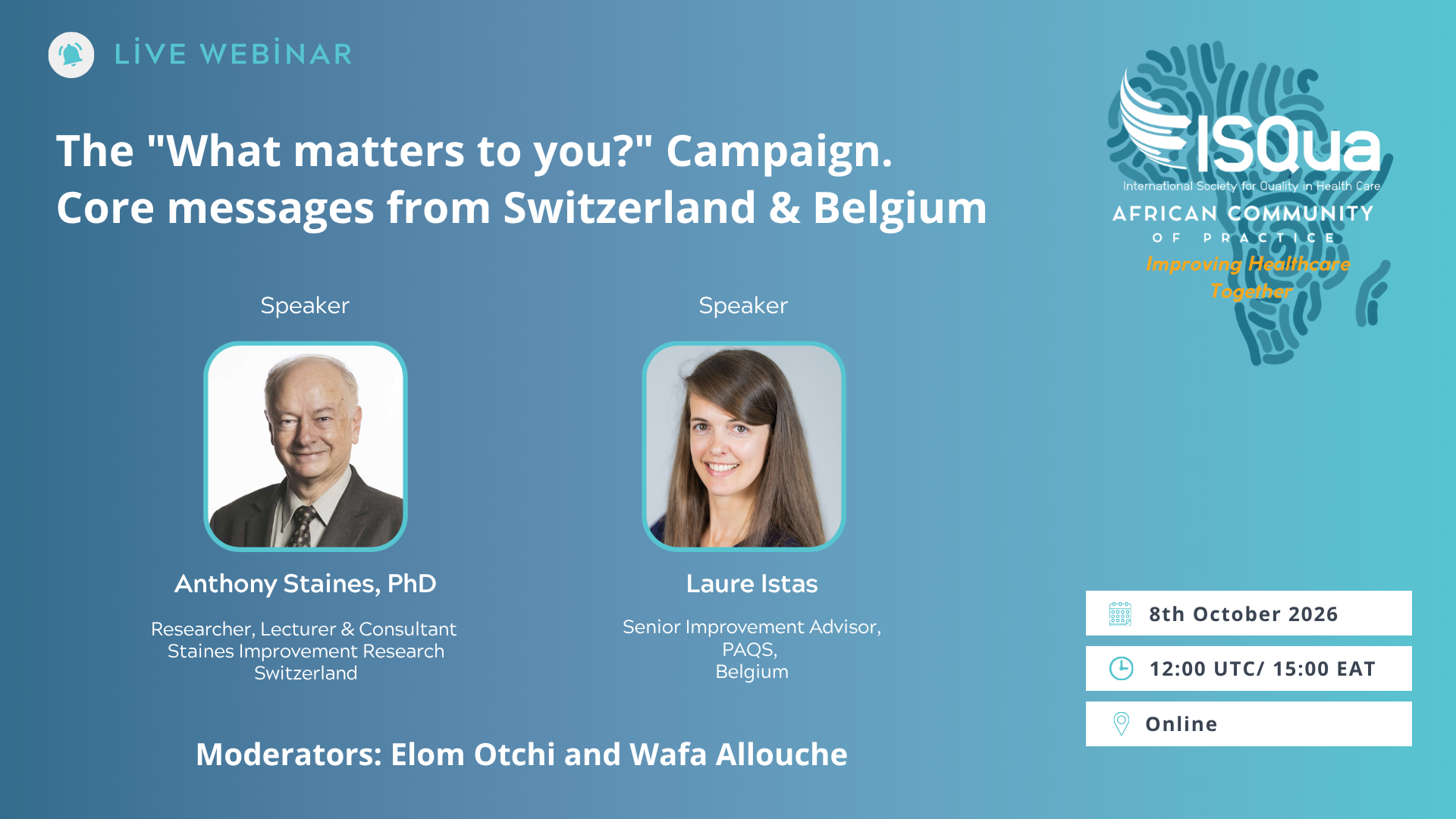
Asking a patient “What matters to you?” costs nothing, takes seconds, and can change the whole course of their care. That was the message at the heart of ISQua’s October Africa Community of Practice (AfCOP) webinar, held on 8th October 2026.
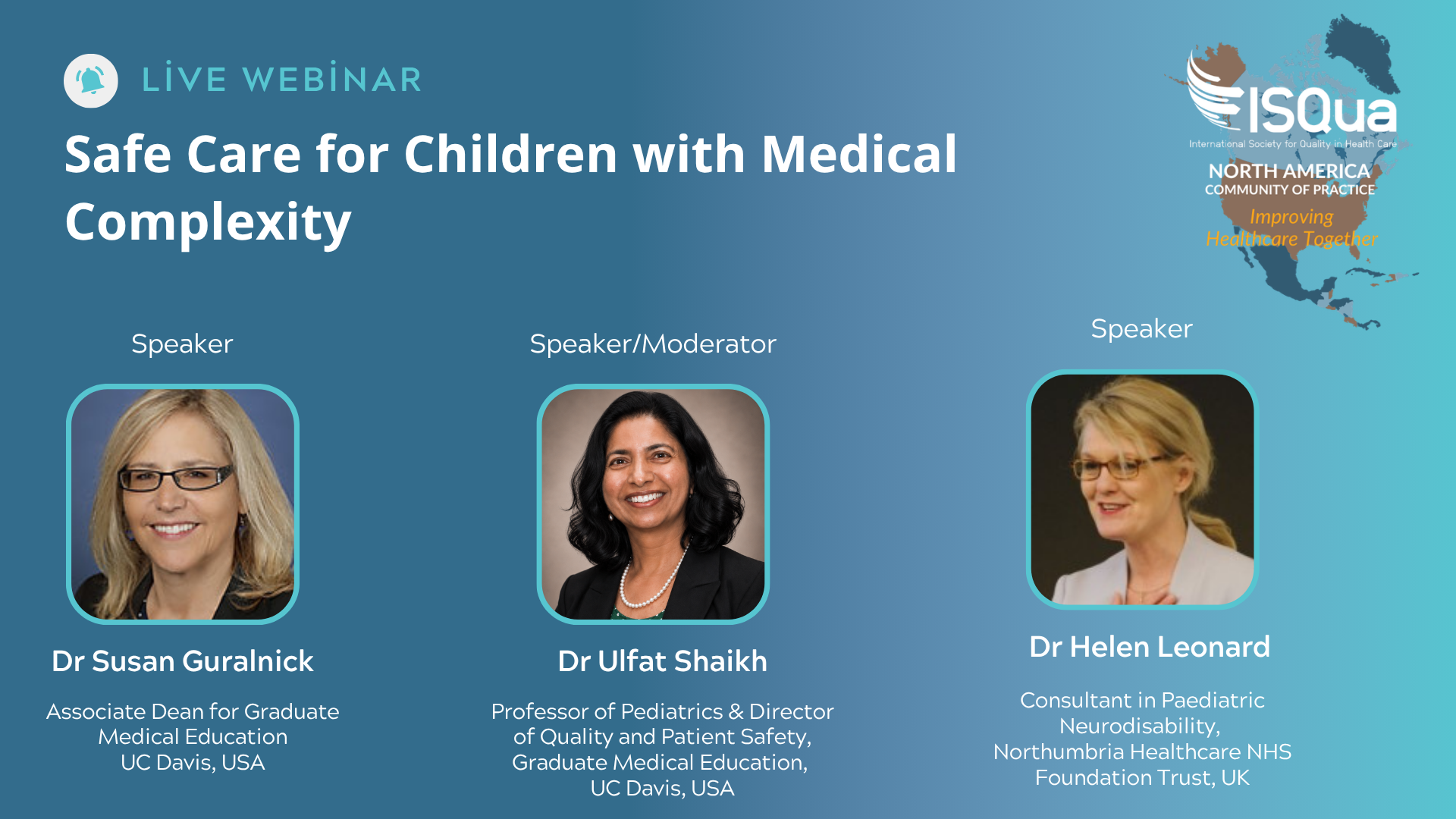
Two leaders of the movement in French-speaking Europe shared what they have learned from years of running the campaign: Laure Istas, Senior Improvement Advisor at PAQS in Belgium, and Anthony Staines, patient safety and quality of care consultant and former patient safety programme director at the Fédération des Hôpitaux Vaudois in Switzerland. The session was moderated by AfCOP’s Dr Elom Otchi and Wafa Allouche.
Participants joined from more than 20 countries, including Ghana, Nigeria, Kenya, Uganda, South Africa, Ethiopia, Egypt, Sierra Leone, the DRC, India and Japan. Simultaneous translation was offered into more than 70 languages, and the chat and Q&A stayed busy for the full session.
From “What’s the matter?” to “What matters to you?”
Anthony opened by tracing the movement back to a 2012 New England Journal of Medicine paper by Michael Barry and Susan Edgman-Levitan on shared decision making. They urged clinicians to give up their role as the single, paternalistic authority and become partners to their patients, asking not only “What’s the matter with you?” but “What matters to you?”
The idea spread fast. Maureen Bisognano, then President of the Institute for Healthcare Improvement, quoted the paper at the IHI/BMJ International Forum in Paris in 2014. Norway’s Anders Vege took the question home to his breakthrough collaboratives, and it grew into a national movement. Scotland, British Columbia and many others followed, leading to an international What Matters to You Day on the first Tuesday of June each year.
At its core, the approach is simple:
- Who asks? Any member of staff, as long as the team shares what it hears and coordinates so patients aren’t asked the same thing repeatedly.
- When? At any point, woven into daily care rather than added on top. It matters most when illness starts to affect quality of life, around a diagnosis, and during shared decision making.
- How? Put the question in context, listen actively, rephrase and check you have understood, act on what you hear where possible, and leave a trace, for example on the bedside whiteboard, at the team briefing or in the discharge letter.
Belgium: patients, staff and the whole organisation
Since 2019, PAQS has run the campaign every year across French-speaking Belgium (Brussels and Wallonia), working with general hospitals, psychiatric hospitals and nursing homes. The French version was developed together with Anthony’s team in Switzerland.
COVID-19 was a turning point. The pandemic brought renewed attention to the wellbeing of healthcare staff, with numerous publications highlighting the pressures they face. This created an opportunity for PAQS to extend the campaign to staff themselves, recognising that asking what matters is just as important for those who provide care as for those who receive it. More recently, publications have increasingly emphasised kindness, compassionate care and the importance of the organisational environment. The campaign also offers an opportunity to turn the question towards the organisation itself, using it to reconnect with its values, revisit its mission and ensure that kindness and compassion are reflected not only in patient care, but also in the way staff are supported and the organisation is led. As Laure put it, asking what matters is the first act of care and a first act of kindness, whoever you ask. The campaign now rests on three pillars:
- Patients: understanding their priorities and preferences.
- Staff: finding out what people need to do their best work.
- The organisation: using the answers to shape values, mission and strategy.
PAQS makes it easy to take part. The campaign peaks on What Matters to You Day, but institutions can run it any time, for example alongside World Patient Safety Day on 17 September. Members receive free posters, stickers, badges, sticky notes and leaflets by post, with more than 8,500 resources distributed so far this year (2026). PAQS evaluates the campaign annually, allowing its resources to evolve in response to the needs of participating institutions. A working group bringing together patients, patient experience officers and staff contributed to the development of new materials: a shorter patient flyer, a colouring sheet for children aged 3 to 12, and a brochure explaining the campaign, how to measure its impact and how managers can use the answers to drive meaningful action.
What it looks like in practice
- Make the question specific. Institutions found that a broad question drew broad answers (“I want to be healthy”). Asking “What matters to you today?” or “What matters to you when finding your way around the hospital?” produced answers teams could act on.
- Trees, boards and sticky notes. Wards hung answers on paper trees, filled hallway posters and used coloured boxes. Some quality coordinators now use AI to transcribe photographed notes and pull out the main themes.
- Every day, not one day. Whiteboards in patient rooms show what matters to that person, so anyone who walks in can start a conversation.
- Patients asking patients. In one psychiatric hospital, the users’ committee went room to room asking fellow patients. Others compared patients’ answers with what staff thought mattered to patients, often with surprising results.
- Asking staff. One psychiatric institution collected sticky notes from staff, yielding 248 ideas for change. Mapped against Maslow’s hierarchy of needs, the top need was protection and security. A hospital transport team said they wanted more recognition and clearer procedures.
- Leaders on the floor. A small psychiatric hospital added the question to its Gemba walks, with directors and quality managers visiting all five units. The answers fed straight into its SWOT analysis and new strategic plan.
Laure’s closing message: adapt it to adopt it. Ask, listen, and above all act, then tell patients and teams what you did with their answers.
Switzerland: from a campaign to everyday practice
Anthony linked the question to two bigger ideas. The first is the Montreal model of patient partnership. Care has moved from a paternalistic model (the team does things to the patient) to patient-centred care (the team does things with the patient). The next step is partnership, where the patient joins the care team and brings experiential knowledge alongside the team’s clinical knowledge. “What matters to you?” is the key that unlocks that partnership.
The second is patient safety. In the Fédération des Hôpitaux Vaudois’s breakthrough collaboratives on adverse drug events, hand hygiene and pressure ulcers, patient engagement kept proving vital. A patient who understands why they need to move regularly can help prevent a pressure ulcer. So, the federation set a goal: the systematic use of What Matters to You in everyday care.
The Vaud hospitals used many of the same tools as Belgium, plus some of their own:
- A five-window cardboard calendar with a different question behind each window, such as “What would make today a better day?” and “What are your goals, and how can we help you reach them?”
- Technical briefs for each activity, a campaign champion on every ward, and coffee mornings led by staff with patients.
- Poster and video contests between hospitals, and ready-made social media posts. One invited professionals to write down what they think matters to three of their patients, then ask them and compare.
- In 2026, every nursing student from a partner university of applied sciences took part in the campaign during their hospital placement and wrote a short report on it.
One hospital’s journey
Réseau Santé Balcon du Jura, a community hospital of about 300 staff in Sainte-Croix, rolled the campaign out across every setting in 2021, from acute wards to its nursing home and radiology. Asking patients before surgery brought answers such as “I’m afraid of waking up alone” and “I’m scared of being cold during the operation”. Both are easy to address once you know.
In 2022 the hospital moved from a one-day campaign to a 365-day one and wrote it into its 2022–2026 strategic plan. Today the question is asked at bedside handovers and daily rounds, and recorded on room whiteboards. The electronic patient record has one box for what matters to the patient and another for what the team did about it. That information appears in the I-PASS structured handoff, and trained handover observers check for it.
Ask, listen, act
The shared PAQS–Swiss logo originally read “Ask, listen, consider”. When the campaign brought a patient mentor onto its organising team, patients said “consider” was not ambitious enough. It is now “Ask, listen, act”, a reminder that the campaign itself should model the partnership it promotes.
From the Q&A
Participants sent in 15 questions, and the discussion focused on how the approach can work in low- and middle-income settings.
How do we avoid widening inequities? Laure suggested asking the question aloud, using interpreters and family members, and writing answers down for people who cannot. Where residents live with dementia, nursing homes ask families and staff what has always mattered to that person. A team in a French island territory translated the question into the local language using pictures. Elom added that equity is a core dimension of quality: the question must reach every patient and colleague, whatever their background or language.
How do patients’ voices actually shape care? Asking is not enough, said Anthony. Hospitals need to be “wired” so answers go somewhere. He described three levels of learning: the patient reflects and expresses what matters; the care team listens, records it and acts; and the institution analyses answers over time and adapts its policies and strategy. Aggregating answers, for example on finding your way around the hospital, can drive wider improvement plans.
What if patients fear complaining or believe nothing will change? Elom described Malawi’s facility ombudsmen and noted that feedback boxes across the continent often go unopened. The speakers’ answer was to keep the question positive. “What matters to you?” is not “What are you complaining about?”, and that changes the relationship. Specific questions, leaflets that invite patients to speak up even if nobody asks, and a simple table in the hospital entrance all lower the threshold.
What communication skills help? Empathy, active listening, rephrasing and teach-back. Giving patients the leaflet in advance also gives them time to think before they answer.
Can it be taught in medical and nursing schools? It is starting to be. PAQS includes a What Matters to You slide in every teaching session, some Swiss schools have begun to integrate it, and trained patient partners now bring the question into research design.
Can it fit into accreditation without becoming a checklist? The question is not an accreditation criterion in itself. It is one tool among several, alongside patient engagement committees and patient partners, for meeting people-centred care standards.
How do clinicians feel about giving up paternalism? Many now accept partnership intellectually, Anthony said, but “in their guts” many are still paternalistic. A campaign like this can help shift culture at scale.
One participant, a quality leader at a 132-year-old teaching hospital in India, shared a powerful example live. The hospital moved from paper complaints to a QR code linked to a simple online form, with live dashboards that alert the responsible team. Daily complaints fell from around 50 to one or two.
Voices from the chat
The chat brought the ideas home. One participant described the first time they asked a patient what mattered to him. He was lonely in a single room, so they moved him to a shared room, and it changed his whole experience of his stay.
Others saw the question as a way to ease the fear and intimidation patients can feel in health facilities. Several noted it could build a more mutual relationship between patients and providers. One organisation said it would make what is often an implied practice explicit, and was “certainly adopting this”.
Participants also raised hard questions that deserve more discussion in future sessions:
- How should quality teams respond when what matters to patients is something the health system cannot yet provide?
- Is the question too broad? One participant argued it may work better focused on one aspect of care at a time, such as premises, schedules or costs. Laure agreed that more specific questions get more useful answers.
- How can facilities encourage patients to raise concerns directly with management rather than seeking public sympathy?
- How have Switzerland and Belgium applied the same thinking to staff wellbeing, engagement and retention?
The movement is also growing nearby. A participant from France’s Grand Est region shared that a pilot is under way there, with independent practitioners also planning to take part.
Try it tomorrow
Elom closed with a challenge: go back to your facility and ask. It is about being kind and compassionate, and it starts with one question. Ask what matters, listen properly, act on what you hear, and let people know what changed.
With thanks to Laure Istas and Anthony Staines for sharing their experience, to moderators Dr Elom Otchi and Wafa Allouche, and to everyone who joined and contributed.
- Watch the full recording: AfCOP – The “What Matters to You?” Campaign: Core messages from Switzerland and Belgium (ISQua login required)
- Join the global movement: resources, translations and monthly calls at wmty.world, hosted by The Beryl Institute
- Join AfCOP: find out more about the Africa Community of Practice and upcoming webinars at isqua.org/community-of-practice/africa. Guest access is free, with reduced membership rates for people based in Africa.